Virtual Glasses
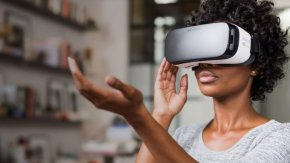
Samara scholars have created a unique practice of early verticalization, which allows patients to get on their feet within 48 hours of stroke.
Read as well.
New development is a child of the Institute of Innovative Development of the Samara State Medical University. The idea belongs to corn medics. The analogs to the practicer of early verticalization, as the developers say, are not in the world today. For the first time, a device has been created that affects at the same time three types of receptors - visual, tactile and hearing.
♪ When a man lay down for a long time, he learns to walk again, the body just forgets how it was done, explains to the WP one of the trainers, the young scientist Alexander Shimanov. - During our session, the lying patient feels like walking.
The RG correspondent felt the operation of the machine. Virtual reality glasses and pneumonics on arms and legs allow simultaneous images and tactile perceptions. And when Alexander put up the pace, she even dizzy. It felt like you were running a soft football field. The left-handed patient, who sees and feels standing and moving, has the memorization of individual muscle groups. The muscles, in turn, launch a back-to-back relationship with the brain. Neural links are being restored. The man "will" to the vertical position, doesn't end up losing his walking skills.
The developers have already shared their practice with practising doctors. 45 patients over 50 years of age were divided into two groups in the Seredouin Regional Hospital. The first group of patients who have just passed the stroke has been rehabilitated standard, and the second has also been rehabilitated with the use of vertical engineering. The Berga balance test (equivalence) demonstrated the effectiveness of the novel. The second group of patients had figures more than twice as good.
Since next year, medicines have planned to commercialize their development. For hospitals, equipment will cost no more than 700,000 roubles, and for patients, privately promise a more accessible set.


